What Matting Does a Climbing Wall Need
Views: 0 Author: Site Editor Publish Time: 2026-11-25 Origin: Site


Is the thrill of climbing truly safe? Imagine reaching for that final crimp. Your forearms burn. Suddenly, your foot slips. In that heart-stopping fraction of a second, the ground rushes up to meet you. Whether you are scaling a route in a bustling commercial gym or tackling a passion project in your backyard, the structure itself is only as good as the protective surface beneath it.
Builders often obsess over hold variety, panel integrity, and the steepness of overhangs. Yet, they frequently overlook the precise engineering required for the flooring. This oversight is a critical mistake. Choosing incorrect materials or inadequate thicknesses leads to severe injuries, wasted financial investments, and devastating liability issues. In this comprehensive guide, you will learn exactly what is required to create a secure landing zone. We will cover everything from calculating vertical metrics to selecting the optimal foam density for ultimate protection.
Key Takeaways
Vertical Metrics Dictate Thickness: The maximum distance an athlete's feet can reach directly determines the required thickness of your protective system.
Landing Zones are Crucial: Protective flooring must extend far enough outward to safely catch a climber who pushes off or falls backward. It cannot merely cover the immediate footprint underneath the panels.
Foam Density Matters: Effective shock attenuation relies on a multi-layer system. This combines a firm closed-cell top layer to distribute weight and a softer open-cell bottom layer to absorb kinetic energy.
Home vs. Commercial Needs: A residential setup might safely utilize high-quality modular crash pads. In contrast, a commercial facility requires seamless, custom-fitted continuous flooring to meet strict liability standards.
Durability Equals Safety: Heavy-duty vinyl covers and consistent maintenance routines are essential to keep your foam performing reliably over years of repeated impacts.
Why Proper Safety Infrastructure is Non-Negotiable
When constructing an indoor or outdoor facility, the visual appeal of the routes often takes precedence during the planning phase. However, the surface underneath remains the most critical component of the entire build. It acts as the ultimate safety net, transforming a potentially catastrophic drop into a controlled and manageable landing.
Recent Industry Trends in Impact Attenuation
In recent years, the indoor climbing sector has witnessed a significant shift toward data-driven safety infrastructure. As the sport's popularity explodes globally, facility owners are no longer settling for generic foam blocks. Insurance underwriters now demand stricter adherence to standardized impact testing. This pressure is pushing manufacturers to innovate with smarter, more resilient materials that maintain their shock-absorbing properties even after thousands of daily impacts. Investing in premium engineered foam is no longer just a safety measure. It has become a crucial business strategy to reduce liability and enhance the long-term user experience.
Preventing Acute and Chronic Injuries
Proper flooring systems are engineered specifically to mitigate the transfer of kinetic energy to the human body during a sudden descent. Picture a climber projecting a steep boulder problem. Because bouldering involves unroped climbing, every route ends in a ground fall. This subjects the musculoskeletal system to immense stress. A scientifically designed padding system decelerates the falling body over a slightly extended period, dramatically reducing the peak force of the impact. This attenuation is vital for reducing the likelihood of acute traumas like fractured ankles, shattered heels, or severe ligament sprains. Furthermore, high-quality flooring absorbs the repetitive shock of controlled drops to prevent chronic joint wear-and-tear over time.
The Psychological Impact on Climbers
From a biomechanical standpoint, safety is entirely about force dissipation. From a practical standpoint, it is about athlete confidence. A well-padded floor directly influences a person’s willingness to execute dynamic movements or attempt challenging routes at their absolute physical limit. When athletes trust the surface below them, the paralyzing fear of a hard landing diminishes. Consequently, this psychological comfort allows for better technique, smoother movement, and a highly focused training experience.
Liability and Safety Standards
For commercial facility operators, adhering to industry safety standards is a strict legal necessity. Organizations and standard-setting bodies provide rigorous guidelines on impact attenuation. Failing to install a compliant system exposes gym owners to severe liability risks, exorbitant insurance premiums, and potential lawsuits in the event of an accident.
Understanding Fall Metrics: How Thick Should Your Protection Be?
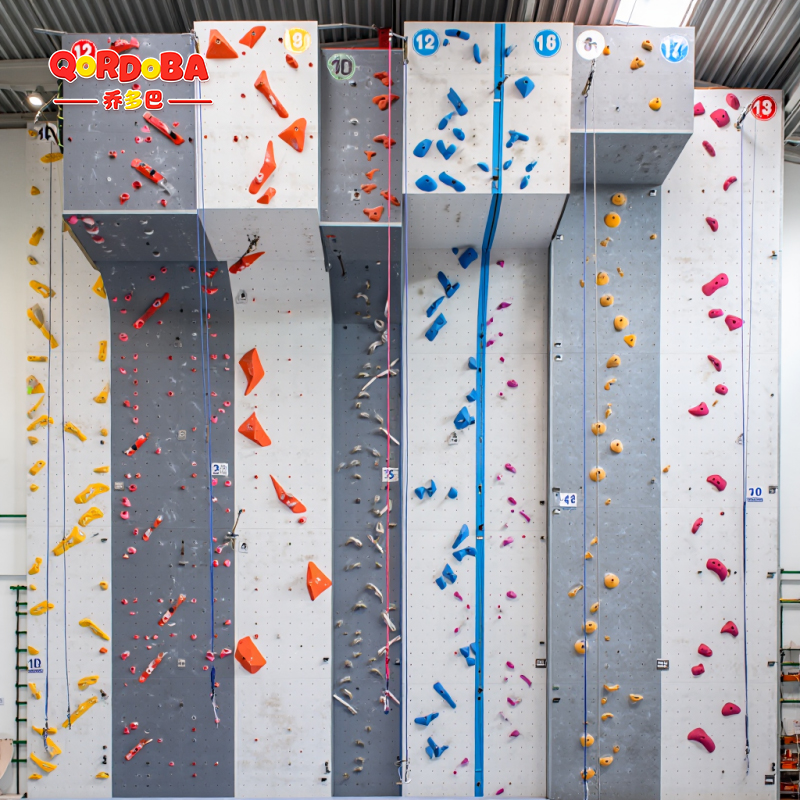
The thickness of your flooring cannot simply be guessed or chosen based on budget constraints. It must be precisely calculated based on specific vertical metrics. The core principle governing these calculations is the maximum foot-level height.
What is Critical Fall Height?
To ensure adequate protection, accurately determining the Fall Height is the most vital step in the planning process. This metric is defined as the maximum vertical distance from the lowest part of the climber's body, typically the feet, to the landing surface. It is a common misconception to measure from the climber's hands or the top edge of the structure. Because athletes descend feet-first in the vast majority of controlled scenarios, the foot-level metric provides the most accurate baseline for determining necessary shock absorption capacity.
Standard Thickness Guidelines
Different climbing disciplines require vastly different safety approaches. Below is a professional reference guide for selecting the appropriate thickness based on the type of facility.
Climbing Discipline | Max Foot Height | Recommended Thickness | Foam Configuration Needed |
|---|---|---|---|
Low Traverse Walls | Up to 3 feet | 2 to 4 inches | Firm dual-density (prevents ankle rolls) |
Roped Climbing | N/A (Rope catches fall) | 2 to 4 inches | Single or dual-density (for low-level slips) |
Standard Bouldering | 10 to 12 feet | 12 to 14 inches | Multi-layer PU/PE sandwich system |
High-Ball Bouldering | 12 to 15+ feet | 14 to 16+ inches | Premium multi-density impact attenuation |
Bouldering eliminates ropes and harnesses entirely. Consequently, the ground surface becomes the sole safety mechanism. These specific setups demand the thickest protection available on the market. In contrast, roped environments serve a fundamentally different biomechanical purpose. The dynamic rope and belay system catch the high-impact falls, meaning the floor padding is primarily designed to protect against low-level slips before the climber clips into the first quickdraw.
Calculating the Impact Area for Your Setup
A thick, premium pad is entirely useless if a falling athlete misses it completely. When athletes peel off a steep overhang, their trajectory rarely follows a perfectly straight vertical line. Gravity and momentum carry them outward, making the expansive coverage of the landing zone an absolute necessity.
Defining the Landing Zone
The Impact Area encompasses the entire predictable landing zone based on the physics of a descending body. It is not simply the footprint directly beneath the panels. Climbers often push off the wall to clear holds, swing outward on a dynamic move, or fall backward due to the angle of the route. The protective surface must account for all these erratic trajectories.
How Far Out Should the Mats Extend?
For strictly vertical surfaces, the general guideline dictates that the flooring should extend at least 6 to 8 feet outward from the base. However, overhanging sections require a much more complex calculation. You must first locate the plumb line, which is the exact vertical drop from the furthest overhanging point of the structure. Subsequently, the flooring must extend an additional 6 to 8 feet outward from that specific plumb line.
Accounting for Side Falls and Swinging
Athletes executing lateral moves or dynamic swings carry horizontal momentum. To adequately account for diagonal trajectories, the protective flooring must extend past the left and right side edges of the structure. A standard recommendation is to extend the surface at least 5 to 6 feet laterally beyond the outermost holds to safely capture an off-center drop.
Types of Protective Surfaces Available
The market offers several distinct categories of protective flooring. Each is engineered for specific environments, budgets, and usage volumes. Selecting the appropriate Padding is crucial for long-term functionality and user safety.
Continuous Flooring Systems
Continuous flooring systems are universally recognized as the gold standard for commercial facilities. These are custom-installed setups featuring a unified, heavy-duty vinyl cover stretched tightly over large, precisely cut foam blocks. Because the top cover is entirely seamless, it eliminates dangerous gaps where a foot could become trapped during a landing. This provides the highest level of liability protection and aesthetic appeal.
Modular and Interlocking Mats
For school gymnasiums, smaller training centers, or high-end residential builds, modular mats offer an excellent balance of professional protection and installation flexibility. These heavy-duty blocks connect to one another via strong, industrial-grade Velcro flaps. When installed correctly and tensioned properly, the Velcro system creates a nearly seamless surface that stubbornly resists separating upon impact.
Drag Mats and Supplemental Padding
Drag mats are thinner, movable pads that are placed directly over the primary flooring system. They are strategically utilized to cover seams in modular setups, provide an extra layer of shock absorption in high-traffic drop zones, or simply keep the primary vinyl surface clean from abrasive shoe rubber and chalk dust.
Foam Composition: What Makes the Best Shock Absorption?
When evaluating safety infrastructure, it is crucial to understand that not all foam is created equal. The exterior cover provides durability, but the internal foam composition dictates the actual life-saving performance. The science of foam density and cellular structure is the foundational element of effective injury prevention.
Open-Cell vs. Closed-Cell Foam
Modern impact attenuation relies on two primary categories of foam. Each serves a distinct biomechanical purpose during an impact event.
Closed-cell foam is typically manufactured from Polyethylene or EVA. This material features a structure where the gas pockets are completely sealed off. Because air cannot escape when compressed, it is highly rigid and firm. Its primary function is load distribution. When an athlete lands feet-first, the firm closed-cell layer spreads the concentrated force of the impact across a much wider surface area, preventing the feet from sinking too quickly and rolling an ankle.
Open-cell foam is usually made from Polyurethane. This material consists of interconnected pockets that allow air to flow freely when compressed. It acts much like a sponge. When a climber falls, the open-cell foam rapidly compresses, expelling air and absorbing the kinetic energy. This controlled deceleration prevents jarring forces that lead to skeletal injuries.
The Dual-Density System
Because neither open-cell nor closed-cell foam is sufficient on its own, the industry standard for premium protection is the dual-density sandwich method. If a pad were made entirely of soft open-cell foam, a falling athlete would bottom out and violently strike the hard subfloor. Conversely, a pad made entirely of rigid closed-cell foam would feel akin to landing on concrete.
The optimal configuration, often seen in professional-grade products, features a thin top layer of firm closed-cell foam to distribute the point-load of the feet. Beneath this sits a thick base layer of soft open-cell foam to absorb the shock and safely decelerate the body.
Vinyl Covers and Exterior Durability
The internal core must be fiercely protected from moisture, chalk, and physical abrasion. The industry standard for the outer shell is heavy-duty, PVC-coated vinyl. This material offers exceptional tear resistance, tensile strength, and is incredibly easy to sanitize. Furthermore, the construction of the cover must feature reinforced, double-stitched seams, as weak stitching will rapidly degrade under the stress of repeated impacts.
Home Setups vs. Commercial Gyms: Key Differences
The context in which a structure is built dramatically alters the requirements for the flooring beneath it. While the basic physics of gravity remain unchanged, the operational demands and legal liabilities differ vastly between residential environments and public facilities.
Solutions for a Home Setup
Building a residential Climbing Wall requires balancing budget limitations with space constraints. A home setup typically sees far less traffic than a commercial gym. High-quality modular mats or a meticulously arranged set of large bouldering crash pads are usually sufficient for personal use.
It is extremely crucial to note that dangerous DIY alternatives like old spring mattresses or discarded couch cushions should never be used. These household items feature unpredictable bounce characteristics and offer zero engineered force dissipation.
Requirements for Commercial Facilities
Commercial gyms operate under intense regulatory scrutiny. For these businesses, flooring is not just a protective measure; it is a critical asset. They require professional installation of seamless continuous flooring to mitigate lawsuit risks associated with twisted ankles or localized failures. In addition, commercial facilities must ensure their flooring transitions comply with local accessibility codes. This requires specific ramp angles and firm edge support to accommodate wheelchairs and prevent tripping hazards.
How to Maintain and Inspect Your Investment
Investing in high-quality Safety Matting pays dividends in injury prevention. However, implementing a rigorous maintenance schedule ensures the materials retain their shock-absorbing properties long-term.
Daily and Weekly Cleaning Routines
Climbing chalk is highly abrasive. When left to accumulate on the vinyl surface, it acts like fine sandpaper against climbers' shoes, prematurely wearing down the PVC coating. Daily maintenance should strictly include vacuuming loose chalk dust and debris. Weekly routines should involve wiping down the covers with non-abrasive, pH-neutral cleaners to prevent the vinyl from becoming brittle over time.
Inspecting for Foam Degradation
Even the highest quality open-cell polyurethane will eventually suffer from compression set. This is a state of fatigue where the cellular structure breaks down and fails to rebound to its original thickness. Facility managers must regularly inspect high-traffic drop zones for depressions or soft spots. If a foot sinks significantly deeper in one specific area compared to the rest of the surface, the internal blocks have degraded and must be replaced immediately.
Seam and Velcro Maintenance
For modular systems, the connection points are the most vulnerable areas. Managers should routinely inspect seams, zippers, and Velcro connectors. A separated seam is a severe hazard. If a foot slips between two disconnected blocks during a fall, the forward momentum can easily cause a fractured tibia. Any tears should be repaired immediately using professional-grade vinyl repair kits.
Conclusion
Constructing a functional and thrilling climbing environment requires meticulous attention to the ground below. Matching the thickness of your flooring to the maximum fall height is the absolute baseline of injury prevention. Always ensure you calculate a wide enough landing zone to capture erratic falls, and select the right dual-density foam configuration to provide both surface stability and deep shock absorption.
Cutting corners on safety infrastructure to save a few dollars is never worth the risk of a catastrophic injury or a crippling lawsuit. Take the time to measure your structure's height and overhang today. Ready to upgrade your facility's safety infrastructure? Explore the professional-grade climbing wall solutions and custom padding options at HQ-Play to secure a protective system tailored to your exact specifications.
FAQ
Can I use old mattresses for my home climbing wall padding?
No, using old mattresses is highly dangerous and strongly advised against. Mattresses are engineered for sleeping, not for decelerating high-velocity impacts. They typically contain metal springs that create unpredictable, dangerous rebound forces, which can throw a falling climber off balance. Furthermore, the memory foam used in bedding lacks the rapid energy dissipation properties required for fall protection. Falling on a mattress often leads to bottoming out against the hard floor or suffering severe ankle injuries.
How thick should matting be for a 10-foot bouldering wall?
For a bouldering wall with a maximum critical fall height of 10 feet, industry guidelines generally recommend a thickness between 12 to 14 inches. This thickness must utilize a dual-density foam system to be effective. The exact thickness within this range depends on the angle of the wall. Steeper walls often result in more horizontal, uncontrolled falls that require the thicker end of the spectrum.
What is the difference between gymnastics mats and climbing wall mats?
While they may look similar externally, their internal construction serves entirely different biomechanical purposes. Gymnastics mats are designed primarily for tumbling and floor routines. They are generally much thinner and consist almost entirely of firm, closed-cell foam to provide a responsive surface for jumping. Climbing mats are built to absorb vertical drops from significant heights. They require a much thicker base of open-cell foam to compress and decelerate a falling body.
How long does climbing wall safety matting last?
The lifespan depends heavily on usage volume, environmental conditions, and maintenance routines. With proper daily cleaning and routine inspections, high-quality commercial padding can last between 5 to 10 years. However, the exterior vinyl and the interior core age differently. High-traffic drop zones may cause the internal open-cell foam to degrade and require replacement every 2 to 3 years, even if the exterior vinyl cover remains in good condition.
Do I need padding if my climbing wall is only for traversing?
Yes, padding is absolutely necessary for traverse walls. Even though traversing keeps climbers low to the ground, the risk of awkward, uncontrolled falls remains high. A climber can easily slip, spin, and fall backward, risking head trauma or rolled ankles upon striking an unprotected floor. For low-height traversing, a thinner dual-density pad ranging from 2 to 4 inches thick is generally sufficient to mitigate these risks effectively.
What is the best foam density for indoor climbing gyms?
The best setup is not a single density, but a multi-layer system. A premium commercial setup typically uses a 1 to 2-inch top layer of high-density closed-cell polyethylene foam to distribute the climber's weight and provide a firm walking surface. Underneath, a 10 to 14-inch base layer of lower-density, open-cell polyurethane foam is used to absorb kinetic energy and cushion the fall.
Are modular crash pads safe for commercial bouldering gyms?
While modular crash pads are excellent for home setups or outdoor bouldering, they are generally not recommended as the primary flooring for large commercial gyms. Commercial facilities face high traffic and strict liability standards. Modular pads can separate over time or create uneven seams, increasing the risk of twisted ankles. Commercial gyms should invest in seamless, continuous flooring systems to ensure maximum safety and compliance.


