How Interactive Projection Keeps Play Areas Fresh
Views: 0 Author: Site Editor Publish Time: 2026-11-04 Origin: Site


Physical playgrounds inevitably lose their appeal over time. Facility operators often watch helplessly as repeat visitor numbers dwindle. Replacing traditional climbing structures requires exorbitant capital. It also forces frustrating facility closures. Fortunately, digital innovation offers a compelling alternative. This comprehensive guide explores how integrating modern projection technology solves this persistent issue. It brilliantly blends active physical exertion with dynamic digital gameplay. We will delve into the underlying mechanics, popular configurations, and technical prerequisites. You will also discover the impressive return on investment these setups deliver to future-proof your entertainment space.
Key Takeaways
Endless Variety: A routine software refresh can completely transform a play area overnight without requiring any physical construction or facility downtime.
Versatile Applications: Dynamic technologies cater to different age groups and activity levels, maximizing the utility of available floor space.
Space Optimization: Understanding technical spatial requirements allows business owners to turn awkward, unused spaces into highly profitable, engaging entertainment zones.
High Return on Investment: Lower maintenance costs, improved hygiene through fewer physical touchpoints, and increased repeat customer rates make this technology a top-tier investment.
The Shift Toward Phygital Play Spaces
Recent industry analyses highlight a massive pivot across the global amusement sector. Out-of-home entertainment venues are expanding rapidly. Consequently, operators face intense pressure to deliver hygienic, highly immersive experiences that justify premium admission prices. Market trends show families actively bypassing traditional, static indoor playgrounds. Instead, they favor tech-forward venues offering dynamic, ever-changing attractions. Modern parents desperately want entertainment options that get children off personal screens. They want them running, jumping, and coordinating with others. Meanwhile, children demand high-level visual stimulation and instant reward loops. Interactive systems bridge this exact gap beautifully.
What is Interactive Projection in Modern Play Areas?
At its core, this commercial entertainment technology merges motion-tracking sensors, robust computing hardware, and commercial-grade laser projectors. It transforms standard physical surfaces into dynamic, responsive games. Blank drywall, vinyl floors, or wooden tables suddenly become interactive canvases. Unlike standard video displays that merely broadcast media, an Interactive Projection system reads physical human movement. It utilizes high-framerate infrared cameras or LiDAR sensors to translate physical motion into digital actions in real time.
The Magic of the Software Refresh: Never a Dull Moment
The core operational advantage of a digital play system lies in its software architecture. Once the equipment is securely mounted to the ceiling or wall, the physical footprint remains completely static. The true value unlocks through remarkable software flexibility.
Consider the lifecycle of a standard physical playground. It remains exactly the same from the day it is built until the day it is eventually torn down. If a facility wants to offer a new thematic experience, management faces a nightmare. They must close off sections, hire contractors, pull permits, and spend thousands of dollars on new structures.
In contrast, executing a digital Content Update allows a facility to change its entire thematic environment in minutes. Through simple software modifications, a venue can run a spooky ghost-hunting game in October. By December, it switches to a snowy ice-skating landscape. Come July, guests enjoy a tropical treasure hunt. This capability drastically reduces capital expenditure over time. Furthermore, it acts as a powerful marketing engine. Promoting fresh games across social media provides a recurring incentive for local families to return.
Top Immersive Setups for Kids
To maximize the appeal of a family entertainment center, operators must deploy different types of immersive setups. These configurations cater to varying age groups, motor skill levels, and spatial constraints.
The Engaging Floor Screen
One of the most popular and accessible configurations available today is the Floor Screen. In this setup, a high-lumen projector mounts securely on the ceiling. It points directly downward to cast a bright, high-resolution image onto the ground. Infrared sensors track the movement of feet, hands, or wheelchairs passing over the illuminated area. Children might find themselves stomping on virtual monsters or playing competitive digital soccer. They could even walk across a simulated pond where the water ripples and koi fish scatter with every single step.
The primary advantage here is unparalleled safety. The game exists entirely as light on a flat surface. Therefore, absolutely no physical obstacles exist. This eliminates tripping hazards entirely. It serves as the perfect entertainment solution for toddlers, early walkers, and mixed-age groups.
The Smash-Hit Ball Wall
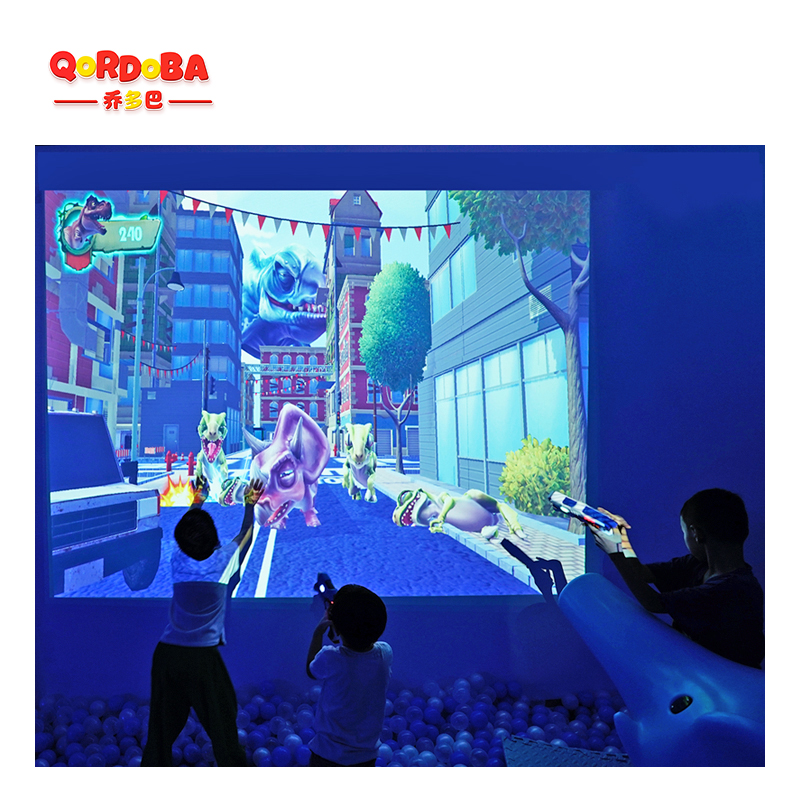
For older children requiring more intense physical exertion, the interactive smash wall serves as the industry standard. The mechanics are highly intuitive. Children throw physical, lightweight plastic balls at a large, durable projected wall to hit moving digital targets. The sensors instantly detect where the physical ball impacts the drywall. The system then triggers a corresponding digital reaction. Players pop virtual balloons, fend off cartoon zombies, or break apart digital brick puzzles. This high-energy Ball Wall environment perfectly marries intense physical exertion with the instant gratification of arcade scoring systems.
Interactive Sandboxes and Slides
Beyond standard flat surfaces, the technology seamlessly extends to specialized playground equipment. Augmented sandboxes utilize depth-sensing cameras to project topographical maps onto physical sand. As children dig valleys or pile up mountains, the projection changes color in real-time. Deep oceans, grassy plains, and snow-capped peaks emerge instantly. Similarly, traditional molded plastic slides can feature motion-reactive graphics. A trail of shooting stars or splashing digital water follows the child sliding down.
Core Comparison: Traditional vs. Digital Play Spaces
To truly understand the operational shift, facility owners must compare the two models side-by-side.
Feature | Traditional Playground | Interactive Projection System |
|---|---|---|
Thematic Flexibility | Static; requires demolition to change | Dynamic; changes instantly via software |
Hygiene & Maintenance | High labor cost; difficult to sanitize ball pits | Low labor cost; simple mop or wipe down |
Space Utilization | Requires massive vertical and horizontal footprints | Adapts to existing blank walls or unused floors |
Safety Profile | Inherent collision and tripping risks | Zero physical obstacles; highly inclusive |
Understanding Setup: Space Requirements and Hardware Specs
When evaluating digital play solutions, the most common question revolves around spatial limitations. Business owners worry about fitting equipment inside their current building without structural modifications. Fortunately, these systems are highly adaptable.
The most critical specification to evaluate is the Projector Throw. In engineering terms, this refers to the distance required between the projector lens and the projection surface to create a specific image size. Standard long-throw projectors are rarely suitable for active entertainment areas. Children constantly run, jump, and throw objects near the surface. A standard-throw setup placed far back in the room results in players stepping into the light beam. This casts massive shadows over the game interface and confuses the motion-tracking sensors.
To circumvent this issue, interactive play areas rely exclusively on short-throw or ultra-short-throw lenses. An ultra-short-throw lens with a 0.4:1 ratio can produce a massive, vibrant image from just a few feet away. This steep projection angle allows the hardware to mount securely on the ceiling directly above the play zone. The light path remains completely clear of the players bodies.
Ambient lighting is another vital consideration. Modern commercial laser projectors feature high lumen outputs, typically ranging from 4,000 to 7,000 ANSI lumens. However, they still struggle against direct, harsh sunlight. For optimal performance and pinpoint sensor accuracy, install these systems in controlled lighting environments. Dimly lit corners or spaces positioned away from large storefront windows provide the ideal canvas.
Why Family Entertainment Centers Are Making the Switch
The rapid transition from purely physical jungle gyms to hybrid digital environments is a calculated operational decision. It is driven by measurable efficiency, hygiene, and inclusivity.
Hygiene and daily maintenance represent a massive operational burden for traditional play spaces. Physical ball pits, climbing ropes, and porous foam block arenas require labor-intensive sanitization. They harbor bacteria and degrade rapidly through constant physical friction. By shifting to digital alternatives, operators drastically cut labor costs. Instead of spending hours scrubbing plastic spheres, a staff member sanitizes a flat vinyl projection surface with a standard mop in under five minutes. The touchless nature of these games lowers germ transmission risks significantly.
Furthermore, digital play environments champion unparalleled inclusivity. Multi-level climbing structures naturally exclude children with mobility limitations. Digital projection systems level the playing field. Children of varying physical abilities participate simply by waving their arms or rolling a wheelchair across a reactive floor.
Maximizing Return on Investment: Cost vs. Long-Term Value
Evaluating the true return on investment requires looking far beyond the initial purchase price. You must analyze long-term operational savings and fresh revenue-generating opportunities.
The initial capital expenditure involves several premium components. You need a commercial-grade laser projector, advanced LiDAR or infrared tracking cameras, a dedicated processing PC, and proprietary software. While this upfront cost rivals a mid-sized physical play structure, the lifetime value heavily tips the financial scales.
When a physical playground loses its novelty, owners spend tens of thousands of dollars on demolition. Refreshing a digital play area requires no construction tape. Facilities download new seasonal software modules for a fraction of the cost. The hardware remains perfectly intact while the guest experience is entirely reimagined.
These systems also unlock highly lucrative upselling opportunities. Many venues designate these tech-forward areas as premium interactive zones, charging a higher entry fee. They are exceptionally profitable for private birthday party rentals. Operators can program the software to project the birthday childs name onto the walls. This delivers a personalized VIP experience that parents willingly pay a premium for.
Choosing the Right System for Your Space: An Engineers Checklist
Selecting the appropriate vendor and hardware configuration dictates the longevity and reliability of your attraction. Approach procurement with a strict focus on commercial-grade durability, sensor accuracy, and software flexibility. Do not settle for consumer-grade home theater equipment.
Hardware Endurance: Consumer-grade projectors fail quickly under the rigorous demands of a commercial venue. Equipment often runs continuously for 10 to 12 hours a day. Insist on commercial-grade laser projectors. Look for sealed optical engines to prevent dust accumulation and a minimum lifespan of 20,000 hours.
Motion Sensor Accuracy: The illusion of digital play shatters immediately if a noticeable lag exists. Systems utilizing advanced 60fps infrared tracking or dual-camera LiDAR provide low-latency responsiveness. When a child throws an object, the system must register the impact instantaneously.
Computing Power: The dedicated PC must handle real-time 3D rendering and sensor data processing simultaneously. Ensure the system includes at least an Intel i5 or i7 processor paired with a dedicated graphics card like a GTX 1650 or higher.
Software Ecosystem: Scrutinize the vendors software interface. It must feature a user-friendly content management system. Non-technical floor staff should easily switch games, schedule content rotations, and adjust volume levels without calling IT support.
Conclusion
Keeping your play area fresh and exciting no longer requires endless cycles of expensive physical construction. Modern projection technology brilliantly merges the necessary physical exercise of traditional playgrounds with the captivating engagement of video games. Because this technology easily adapts to existing floor plans and drastically reduces maintenance overhead, it stands as one of the smartest upgrades an operator can make.
Evaluate your available space and calculate your spatial requirements today. If you are ready to future-proof your entertainment business, explore the professional-grade solutions at HQ-Play. Upgrading to a dynamic digital system ensures your venue remains the top destination for local families year after year.
FAQ
How often should I perform a software content update on my system?
Industry data suggests rotating your game library every three to four months is optimal for maintaining customer interest. Aligning these updates with major holidays, seasonal changes, or school vacation periods provides a reliable marketing hook. This strategy prevents the attraction from feeling stale without incurring heavy physical renovation costs.
Can a projected wall setup handle hard throws from older children?
Yes, these setups are specifically engineered for high-impact physical play. The digital image is cast onto a physical, durable wall surface. Reinforced drywall, wood, or heavy-duty vinyl absorbs the physical impact of the plastic balls. The delicate electronic components remain securely mounted on the ceiling, completely safe and out of harms way.
What kind of flooring is best for a floor-based projection?
For optimal visual clarity and sensor tracking, light-colored, matte, and seamless flooring is highly recommended. Materials such as white or light grey vinyl, commercial linoleum, or dense EVA foam mats provide an excellent projection canvas. Dark floors absorb light, while highly glossy surfaces create severe glare that confuses infrared motion sensors.
Do I need a massive space to install this technology?
Not necessarily. The adaptability of this technology is a primary advantage. Thanks to modern ultra-short-throw lenses, even tight corners, narrow hallways, or small waiting rooms transform efficiently into engaging digital zones. Operators can maximize the utility of awkward, previously unused square footage.
What is the lifespan of the commercial projector hardware?
Commercial-grade laser projectors used in these setups are built for endurance. Most reputable systems feature a laser light source rated for at least 20,000 hours of continuous use. In a typical family entertainment center operating 10 hours a day, the light source will last over five years before requiring any significant maintenance or replacement.
Can I install these systems on my existing drywall?
Absolutely. Standard flat drywall is an excellent surface for wall-based games. For high-impact setups where children throw physical objects, we recommend reinforcing standard drywall with a layer of plywood or using a heavy-duty vinyl overlay to prevent long-term denting. The projection technology itself adapts perfectly to your existing structural walls.
Is interactive projection safe for toddlers?
Absolutely. Digital floor games are widely considered one of the safest active play options for early childhood demographics. Because the game environment is entirely virtual, there are no physical obstacles to navigate or moving mechanical parts. This eliminates tripping hazards, allowing toddlers to run and crawl in a completely secure, barrier-free environment.


