
Operating a commercial play facility requires strict adherence to established safety standards. Compliance forms the absolute foundation of your operational continuity, liability mitigation, and brand trust. A single structural failure or overlooked hazard can lead to severe injuries, immediate facility closure, and devastating lawsuits. Facility owners and investors face the challenge of navigating fragmented safety regulations across different jurisdictions. You must distinguish between genuinely certified manufacturers and those cutting corners, while actively avoiding non-compliant, high-risk equipment. This guide breaks down mandatory safety standards and outlines exact specifications for selecting compliant equipment. We will show you how to implement strict operational protocols that protect children, satisfy local inspectors, and secure your business against preventable risks.
Regulatory Baselines: ASTM F1918-12 is the primary authoritative standard for indoor playgrounds, dictating structural integrity, material safety, and layout.
Hazard Prevention: Strict adherence to spacing guidelines (e.g., the 3.5-inch to 9-inch rule) and hardware design is non-negotiable to prevent head, neck, limb entrapment, and clothing entanglement.
Equipment Sourcing: Evaluating indoor playground safety equipment requires verified third-party testing documentation for fire retardancy, impact attenuation, and non-toxicity.
Operational Readiness: Long-term safety relies on a combination of professional installation, routine third-party audits, documented staff training protocols, and transparent communication with parents.
ASTM F1918-12 serves as the primary standard developed specifically for soft contained commercial indoor play systems. Unlike outdoor playground standards, this specification addresses the unique environmental factors of enclosed play spaces. It dictates the structural capacity required for pipe-and-clamp framing systems. Installers typically use 48mm galvanized steel pipes with a minimum wall thickness of 2.0mm to meet these load-bearing requirements. The standard establishes strict guidelines for accessibility, platform weight limits, and emergency egress within multi-level enclosed structures.
Adherence to ASTM F1918-12 directly impacts your commercial liability insurance premiums. Insurers require documented proof that your facility meets these baseline safety metrics before underwriting a policy. Operating outside these parameters strips away your legal protections. If an incident occurs on non-compliant equipment, the facility owner bears total negligence. The standard covers critical elements including a minimum load rating of 50 pounds per square foot on elevated platforms, the structural integrity of perimeter netting, and the specific design of emergency access hatches in enclosed tube slides.
Global or cross-border operators must understand European standards alongside ASTM guidelines. EN 1176 governs the general safety requirements for commercial play equipment. EN 1177 dictates the specific testing methods for impact-attenuating surfacing. Facilities operating in Europe or purchasing equipment from European manufacturers must verify compliance with these specific EN codes. They share similar hazard prevention principles with ASTM but require different testing methodologies for material toxicity and structural load.
Playground-specific standards intersect heavily with local municipal building codes. You must align your equipment layout with local fire marshal regulations. Fire codes dictate sprinkler placement, requiring a minimum clearance of 18 inches between the top of the play structure and the sprinkler heads. They also mandate unobstructed emergency exit routes and the maximum occupancy of contained play zones. ADA compliance or regional accessibility equivalents require you to integrate accessible ground-level play events and proper transfer stations. Ignoring local municipal codes during the design phase results in failed opening inspections and costly structural modifications.
The materials used in your play structure require rigorous evaluation. Children constantly touch, climb on, and occasionally bite the surfaces of soft play equipment. All plastics, high-density foams, and PVC vinyl coverings must be certified non-toxic. You must demand documentation proving all materials are completely lead-free and phthalate-free. Low-grade PVC often contains harmful plasticizers that degrade over time, posing severe health risks in enclosed environments. High-quality Indoor Playground Safety Equipment utilizes 0.55mm thick PVC vinyl wrapped around high-density EPE foam to ensure both durability and chemical safety.
Fire retardancy is equally critical. Every piece of netting, foam padding, and structural fabric must carry NFPA 701 fire-retardant certifications or their regional equivalents. In an enclosed commercial space, highly flammable plastics accelerate fire spread and produce toxic smoke. Inspectors will check the fire ratings of your zip ties, post padding, and floor mats. Equipment lacking verified fire-retardant documentation will fail municipal fire inspections immediately.
Entrapment represents one of the most severe risks in commercial play structures. The physics of entrapment occur when a child's body passes through an opening, but their head or neck catches on the surrounding frame. To prevent this, you must enforce strict spacing requirements. All openings in guard rails, ladder rungs, and netting must be less than 3.5 inches or greater than 9 inches. A 3.5-inch gap prevents a small child's torso from passing through. A gap larger than 9 inches ensures that if a body passes through, the head will easily follow without restriction.
You must inspect every netting panel and barrier for compliance with this rule. Netting mesh sizes must be small enough to prevent fingers from getting caught and twisted. Protrusion and shape hazards require equal attention. Equipment design must completely eliminate sharp edges and exposed bolts. Hardware must be countersunk or covered with rounded, impact-absorbing caps. V-shaped angles in structural framing or slide exits are strictly prohibited. These angles act as catch points for clothing, drawstrings, or hoods, which leads to strangulation.
Flooring is an active safety system, not just a decorative surface. Critical Fall Height (CFH) dictates the required thickness and density of your impact-attenuating flooring. CFH is the maximum height from which a child can fall onto the surface without sustaining a life-threatening head injury. If your highest accessible platform is 8 feet, your flooring system must be rated for an 8-foot CFH.
Different flooring systems offer varying levels of shock absorption, durability, and maintenance requirements. You must select the system that matches your specific equipment heights and traffic volume.
Flooring System Comparison for Play Facilities
Flooring Type | Shock Absorption (CFH Rating) | Durability | Maintenance Trade-offs |
|---|---|---|---|
EVA Foam Mats | Low to Medium (Requires stacking for higher CFH) | Moderate. Prone to surface wear and puncturing. | Easy to replace individual tiles. Difficult to sanitize seams. |
Poured-in-Place (PIP) Rubber | High (Customizable thickness for maximum CFH) | Excellent. Withstands heavy foot traffic. | Seamless surface is easy to clean. Expensive to repair damages. |
Modular Impact Tiles | Medium to High (Engineered impact pillars) | High. Resistant to tearing and compression. | Allows airflow and drainage. Dirt can accumulate beneath tiles. |
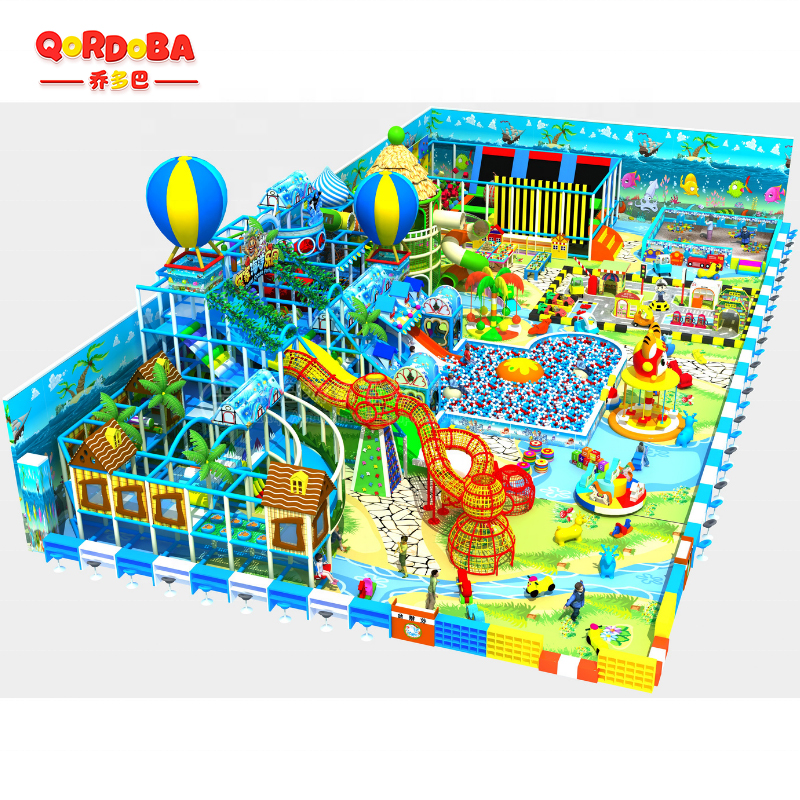
Physical separation between different age groups is a fundamental safety requirement. Toddlers ages 0-3 lack the spatial awareness and physical coordination of older children. Mixing these groups in a high-energy environment inevitably leads to collision injuries. You must physically separate toddler zones from the main play structures designed for children ages 4-12.
Use structural barriers to enforce these age-restricted zones. Half-walls, padded bench seating, and enclosed netting provide clear physical boundaries. Visual cues, such as distinct flooring colors or themed entry arches, help parents and staff identify the separate areas. These barriers maintain safety without compromising the open aesthetic of your facility. Ensure the toddler area features scaled-down equipment with lower fall heights and softer materials to match their developmental stage.
Proper spatial layout prevents congestion and collision hazards. You must maintain at least 6 feet of unobstructed clearance around all active equipment zones. Slide exits, swing zones, and the bases of climbing walls require this dedicated run-out space. If a child exits a slide at high speed, they need adequate room to decelerate and stand up before crossing another child's path.
Walkways must remain wide and completely unobstructed. Design your layout to facilitate intuitive traffic flow, preventing bottlenecks near popular attractions or facility entrances. Emergency egress routing within complex, multi-level structures requires careful planning. Children must be able to exit the structure quickly during an emergency. Incorporate clear, direct pathways to the ground level and ensure all enclosed tubes feature accessible escape hatches for staff to perform extractions.
Line-of-sight is a critical safety feature for both parents and floor staff. If you cannot see a child, you cannot supervise them. Complex multi-level structures often create dangerous blind spots. You must design your layout to maximize visibility across the entire play floor.
Use clear polycarbonate panels instead of solid walls in high-elevation platforms. Install transparent or wide-mesh netting on the outer perimeter of the structure. Minimize blind spots in enclosed tubes by keeping them short or using clear plastic sections. Corner installations require strategic mirror placement or open-front designs to ensure staff can monitor activity from the main floor. Effective sightlines allow parents to monitor their children comfortably and enable staff to identify and respond to safety hazards instantly.
Sourcing a compliant Indoor Playground requires aggressive vetting of potential vendors. Do not accept generic claims of safety. You must request specific TUV, CE, or ASTM compliance certificates. These certificates must tie directly to the exact equipment models you intend to purchase. A certificate for a single plastic panel does not validate the safety of an entire multi-level structure.
Avoid purchasing white-labeled equipment from unverified overseas suppliers. These products often lack traceable safety testing documentation. They use substandard steel, toxic plastics, or weak netting that fails under commercial stress. If a vendor hesitates to provide independent laboratory testing results for fire retardancy, material toxicity, and structural load capacity, disqualify them immediately. Traceability is your only defense against liability.
Follow these steps to verify vendor documentation:
Request the full, unredacted laboratory testing report for the specific equipment model.
Verify the testing laboratory is an accredited third-party facility (e.g., SGS, TUV Rheinland).
Cross-reference the materials listed in the report with the materials specified in your purchase contract.
Check the expiration date on all safety certificates to ensure they are current.
Installation determines whether safe equipment remains safe in practice. Using in-house contractors or general handymen introduces massive liability trade-offs. Commercial play structures require precise assembly. Bolts must be torqued to specific tolerances. Netting must be tensioned correctly using heavy-duty zip ties (minimum 120 lb tensile strength) spaced every 4 inches to prevent sagging and entrapment hazards. Foam padding must be secured tightly without exposing the underlying steel frame.
Improper installation immediately voids equipment warranties. It shifts the entire liability burden onto the facility owner. Always utilize manufacturer-certified installation teams or specialized playground construction crews. These professionals understand the nuances of pipe-and-clamp systems and structural anchoring. They ensure the physical assembly perfectly matches the engineered safety specifications.
Never open your facility to the public without a final, independent safety audit. Commission a Certified Playground Safety Inspector (CPSI) to evaluate the completed installation. The inspector will use specialized tools, such as articulation probes, to test for entrapment hazards. They will verify that all clearances meet ASTM standards and that the flooring thickness matches the required critical fall heights.
A post-installation audit provides a comprehensive punch list of required adjustments. Document every finding and ensure the installation team corrects all issues before final sign-off. Keep the final passing inspection report on file permanently. This document is essential for securing your commercial liability insurance and proving due diligence in the event of a future legal claim.
Safety requires continuous operational discipline. You must implement a structured schedule for daily, weekly, and monthly equipment inspections. Daily checks involve staff walking the floor before opening to identify obvious hazards like bodily fluids, foreign objects, or torn netting. Weekly inspections require a deeper look at structural integrity, checking for loose bolts or shifting floor mats.
Identify high-wear components and replace them proactively. Zip ties securing the netting degrade and snap over time. Foam padding on high-traffic corner posts compresses and tears. Netting attachments near slide entrances experience heavy tension and require frequent monitoring. Do not wait for a component to fail completely before replacing it. Maintain a stock of spare parts on-site to address maintenance issues immediately.
Recommended Preventative Maintenance Schedule
Inspection Frequency | Components to Check | Action Required |
|---|---|---|
Daily (Pre-Opening) | Floor mats, ball pits, slide exits, netting panels. | Remove debris, sanitize surfaces, check for visible tears or bodily fluids. |
Weekly | Zip ties, foam padding, safety caps, moving parts (spinners). | Replace broken zip ties, re-secure loose padding, lubricate bearings. |
Monthly | Structural pipe clamps, floor anchoring, emergency hatches. | Re-torque loose bolts, verify anchor stability, test hatch hinges. |
Your floor staff act as the first line of defense against accidents. They require rigorous training in core competencies specific to commercial play environments. Staff must master capacity management, ensuring specific zones do not exceed their engineered occupancy limits. They need conflict resolution skills to manage aggressive play and enforce rules with both children and parents.
Emergency evacuation procedures require physical practice. Staff must know exactly how to safely extract a panicked or injured child from an enclosed tube slide or a high-level platform. Train your team on the critical difference between active monitoring and passive supervision. Staff should not stand statically in corners. They must patrol the floor, actively scanning blind spots, monitoring traffic flow, and intervening before risky behavior results in an injury.
Hygiene directly impacts facility safety. High-traffic play areas act as vectors for bacterial and viral transmission. You must establish strict sanitation protocols for all surfaces. Ball pits, vinyl padding, and interactive electronic panels require daily cleaning. Use non-toxic, hospital-grade quaternary ammonium disinfectants. These chemicals effectively kill pathogens without leaving toxic residues that could harm children.
Implement a deep-cleaning schedule for hard-to-reach areas. Ball pits require specialized cleaning machines that extract, sanitize, and dry the balls while vacuuming the pit floor. Sanitize high-touch areas like handholds, steering wheels, and slide entry points multiple times throughout the operating day. A visibly clean facility reassures parents and prevents localized disease outbreaks.
Transparent communication turns your safety compliance into a powerful brand trust-building tool. Parents want to know their children are protected. Leverage your investment in safety by making it visible. Post clear, professionally designed safety signage at the entrance of every play zone. Clearly state age restrictions, capacity limits, and behavioral rules.
Educate parents on their specific role in monitoring their children. While your staff provides active floor monitoring, parents retain the primary responsibility for their child's behavior. Use entry waivers and facility signage to set clear expectations. Highlight your cleaning schedules and safety certifications on your website and social media. When parents understand the rigorous standards you enforce, they become loyal, repeat customers.
Cutting corners on indoor playground safety standards introduces unacceptable financial and operational risks. Compliance drives long-term profitability. A safe facility avoids lawsuits, prevents costly shutdowns, and builds an unshakeable reputation among local families. You must treat safety as an ongoing operational strategy.
Take the following actions to secure your facility:
Request comprehensive, unredacted safety compliance portfolios from all prospective vendors.
Disqualify any manufacturer unable to produce verifiable third-party testing documentation.
Consult with a local Certified Playground Safety Inspector (CPSI) during your design phase to identify layout flaws early.
Hire only manufacturer-certified installation teams to assemble your play structures.
Draft and implement your facility's standard operating procedures for daily maintenance, staff training, and emergency response.
A: ASTM F1918-12 is the standard specification for soft contained play equipment. It serves as the primary authoritative guideline for commercial indoor play facilities. The standard covers structural design, manufacturing requirements, material safety, and installation protocols to ensure enclosed play environments minimize injury risks.
A: The industry standard requires maintaining at least 6 feet of unobstructed clearance around all active play structures. This includes slide exits, swing zones, and climbing wall bases. This clearance zone provides children with adequate space to decelerate and exit the area without colliding with other users or structural walls.
A: This critical rule prevents fatal head and neck entrapment. All openings in guard rails, ladder rungs, and netting must be smaller than 3.5 inches so a child's torso cannot pass through, or larger than 9 inches so if the body passes, the head can easily follow without getting stuck.
A: Equipment design must eliminate sharp edges, exposed bolts, and V-shaped angles. Countersunk hardware and rounded caps prevent protrusion injuries, such as cuts or blunt force trauma. Avoiding V-shaped angles in framing and slides prevents clothing, drawstrings, or hoods from catching, which eliminates severe strangulation hazards.
A: Commercial equipment requires highly durable, non-toxic materials. Plastics and vinyl must be certified lead-free and phthalate-free. Flooring and structural padding must use high-density impact-absorbing foam. Crucially, all netting, fabrics, and padding must carry NFPA 701 (or equivalent) certifications proving they are fire-retardant.
A: Facilities require a tiered inspection approach. Floor staff must conduct daily visual checks for hazards and bodily fluids before opening. Maintenance teams should perform detailed weekly or monthly checks on structural integrity and high-wear parts. Finally, a certified third-party inspector (CPSI) should conduct a comprehensive annual audit.
A: Yes. While basic fall attenuation principles remain similar, indoor environments face unique risks. Indoor standards focus heavily on strict fire retardancy, emergency egress from contained spaces, structural load on pipe-and-clamp frames, and rigorous sanitation protocols, governed by ASTM F1918 rather than outdoor standards like ASTM F1487.
